Introduction
Event-Driven home Automation Architecture is now new concept in smart home automation. Smart home are now not limited to only simple automation of appliances and lights. It has improved and evolved far better than that. It contains now modern intelligent eco system where devices directly communicate and react to real life events into real time. Event-Driven home Automation Architecture (EDA) is now heart of the system as devices responds to environmental changes, system events and behavior of the user. During traditional event organization delay may happen, or anything unusual can happen but due to this system tasks runs in fixed time.
Event-Driven home Automation Architecture (EDA) provides flexibility, real time responsiveness. So, this article is basically depends upon what is EDA, how it works, what are the benefits of using it, real life examples and future trends of the same. So, by reading it you will get idea about how this system converts home into smart home and effective living environment.
1.What is Event-Driven Home Automation Architecture in smart home?
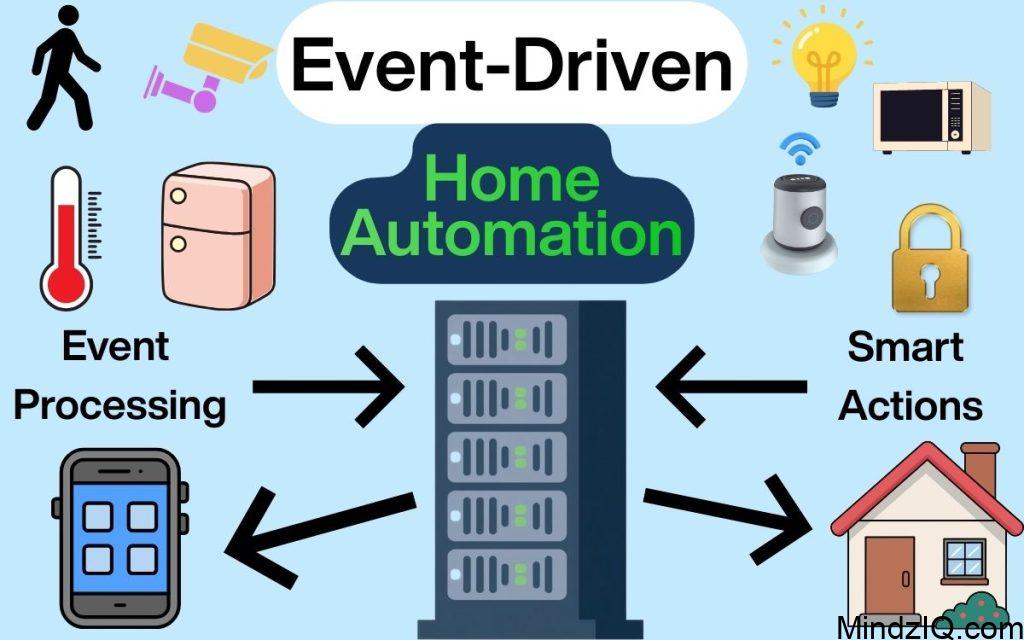
Basically it is the system which responds according to detectable change in environment or event. In the smart home we can arrange events based on automation and, user interaction and sensors rather than manually intervention and preplanned schedules.
a) What is an Event?
It is and noticeable change in the environment or home that system can detect.
i. Temperature Fluctuation beyond set threshold
ii. Open/Closed doors or windows
iii. Motion of person in room
iv. Voice commands by assistant
v. Security breaches that can be detected by sensors and cameras
b) Schedule based/ Vs Event automation
In traditional event organizing home automation system is based on time. There will be executing pre programmed tasks like turn on light at specific time, turn on coffee machine at specific time. Sometimes there will be failing to real conditions or delay.
Event driven systems are driven. They only responds when they detect any change or event occurs. They provide :
i. Real time response
ii. Reduced energy wasting
iii. Personalized automation
c) Why event based systems are ideal for smart homes?
In smart home their may be multiple cross platforms or multiple devices and ecosystem. Event-Driven system coordinate all the devices and provide service by ensuring below points:
i. Responds when necessary
ii. Actions are based on real world triggers
iii. User can combine multiple event by defining complex rules.
2.Key Points of Event-Driven Home Automation Architecture in smart home
EDA system contains critical components on which it works. So, understanding each and every points is necessary before working with such system.
a) Event sources/ Sensors:
They are the primary content of the system. Which notices or detects the change in the environment and pass the information to the system. The below are the different types of the sensors.
1. Motion sensors- Detects movements in surrounding like rooms or hallways
2. Door/Window sensors- They track the opening and closing of the doors and windows
3. Cameras- The monitor recording, video, and AI- powered detection
4. temperature and Humidity sensors- They detects if temperature falls or raised beyond predefined limit or detects climatic changes
5. water/Gas/Smoke assistant- Detects any unusual incidence happens and triggers emergency action
6.Voice Assistant- Captures the commands and take action on the same
b) Event Bus/ Event broker:
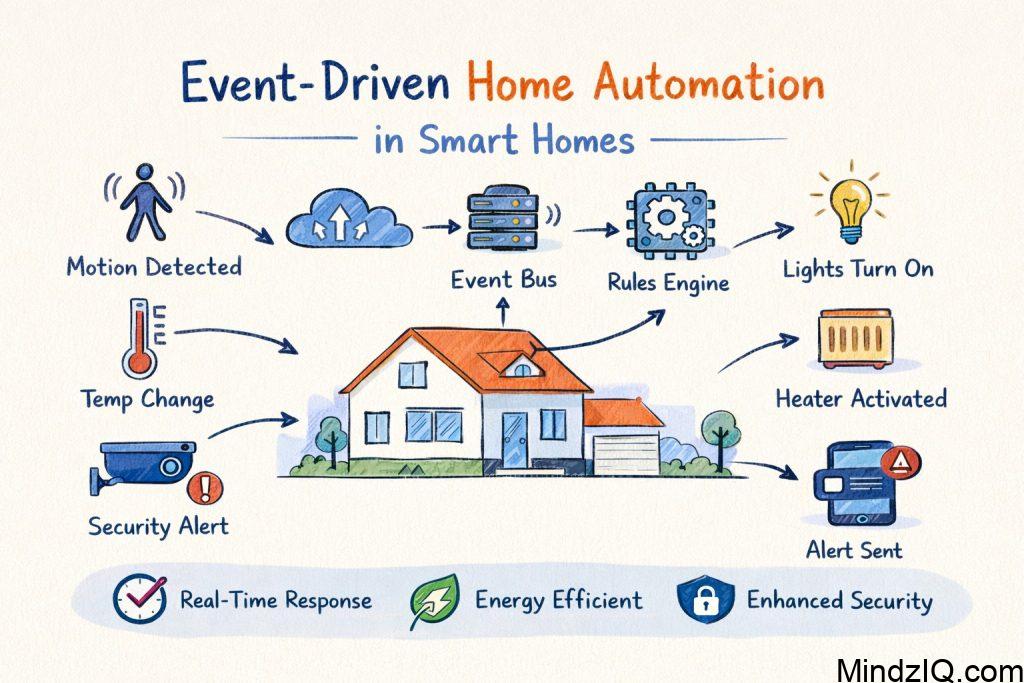
If any event occurs first it get detected by event sources then next role is of event bus which is the backbone of communication. Which plays main role in the collecting, routing and distributing the events in the relevant components. Most popular technologies are:
– Apache Kafka
-MQTT
– Cloud based hub
Benefits of Event bus are:
i. Scalability
ii. Real-time event delivery
iii. Reliable communication
c) Event processor/Rules Engine
If event happens, firstly it is detected then it is routed towards relevant components now next step is to take action on the same. So, Event processor plays role like brain of home automation. It evaluates the event and decides what appropriate action should be taken.
Features of Event processor:
- Integration with AI
- Combining multiple events
- Conditional evaluation
Ex. If any motion detects in living room and after sunset then turn on the lights. Advanced processors learn this patterns and automatically rules for comfort and efficiency.
d) Event Consumers/ Actuators
These are the devices which carry out the actions in response to processed events.
ex. Alarm System, Smart switches, Thermostats, Door locks, Smart plugs, Appliances.
When the system detects that door is open at night time it may turn on entrance light, send notification to homeowner or may record video through camera.
e) Monitoring/ User Interface
This allows user to monitor the events, fix the rules and get alerts.
Interfaces can be:
-Web dashboards
-Voice assistants
-Smartphone
The best user interface provides easy rule making and modifications, emergency notification and event logs.
3. Working of Event-Driven Home Automation Works (EDA):
Let understand this process by an example i.e. Automated light and climate control
Place: Smart living room Automation
Step 1: Event Detection:
Motion in the living room will be detected by motion sensor and room temperature will be detected by Temperature sensor.
Step 2: Event Transmission
This sensors sent detected event to event bus
Step 3: Event processing:
Rules engine evaluate the event.
- If motion is detected in living and after sunset lights will be turned on
- If temperature is below fixed temperature room heater will be activated
Step 4: Action Execution:
Lights turn on and heater will be adjusted to comfortable temperature
Step 5: Optional Notifications:
Smartphone apps will send alert notification to the user i.e Lights and heater is activated in living room.
This clarifies that how multiple events can simultaneously triggers the multiple actions, giving seamless smart home experience.
4. Advantages of EDA:
Over traditional system EDA provides several advantages.
i. Real-Time response
Actions occurs immediately after events improves users satisfaction.
ii. Flexibility
User can combine multiple system, can customize the rules
iii. Scalability
It scale efficiently as multiple devices added to smart home ecosystem.
iv. Energy efficiency
As system works only when there is need hence electricity use is reduced.
V. Enhanced Security
Real time alerts and responses increases home safety
Vi. Improved user experience
System provides more natural and seamless interaction
5. Real-world example of EDA
| EVENT | ACTION |
| Detection of motion in living room | Automatically lights turn on |
| Door opens and alarm armed | Camera recording starts and alerts send to user |
| Temperature below 20oc | Room heater activates |
| Voice commands for morning | Adjust thermostat, Start coffee machine and open blinds |
| Smoke detection | Turn on alarms, unlock the doors and notification sent to homeowner. |
| No any movement in living room for more than 15 min | Automatic lights and AC turn off |
6. Challenges of Event-Driven Home Automation:
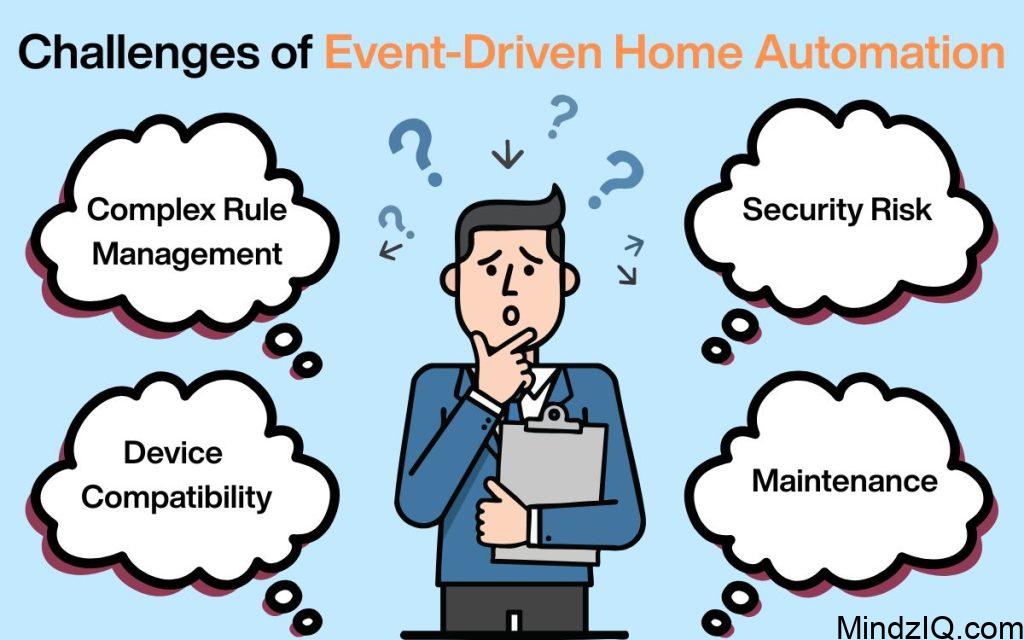
Beside advantages there are some disadvantages of EDA:
i. Complex rule management: Multiple events and actions becomes difficult to monitor
ii. Security Risk: Network based devices have risk of hacking
iii. Device compatibility: Different users uses different network connection like Wi-Fi, Zigbee
iv. Maintenance: Sensors may requires calibration, software updating and changing battery
7. Future Trends in EDA:
The future of Event-Driven home automation is to create more efficient and smart homes. AI- powered systems will learn your habit and will give response to your need before any event happens and will your home more responsive and effective. Cross-ecosystem will work together without any issue and will provide you smooth experience. Energy will also get optimized and there are much more advantages of EDA to make your home smart. This system will give you better experience and may feel you more comfortable and convenient.
Conclusion:
EDA represents significant advancement in technology for smart home. Homes are becoming more secure, Convenient and efficient. This devices responds immediately to the events. This technology user friendly, energy efficient which creates future where homes enhances comfort and improve quality of life with anticipating the needs.
Read More: The Powerful Benefits and Drawbacks of Smart Home Automation.