
Introduction:
Circadian lighting is matching your indoor lights to the beat your body already expects. Day time lights helps you to feel alert and focused while evening or night times light helps your body to calm and ready for sleep. When it is properly fixed it feels natural like.
Your home will just knows what kind of light you need. This will get even better when you automate this with motion sensors (Detects presence in living room) and lux sensors (Detect light already present).
What Is Circadian Lighting?
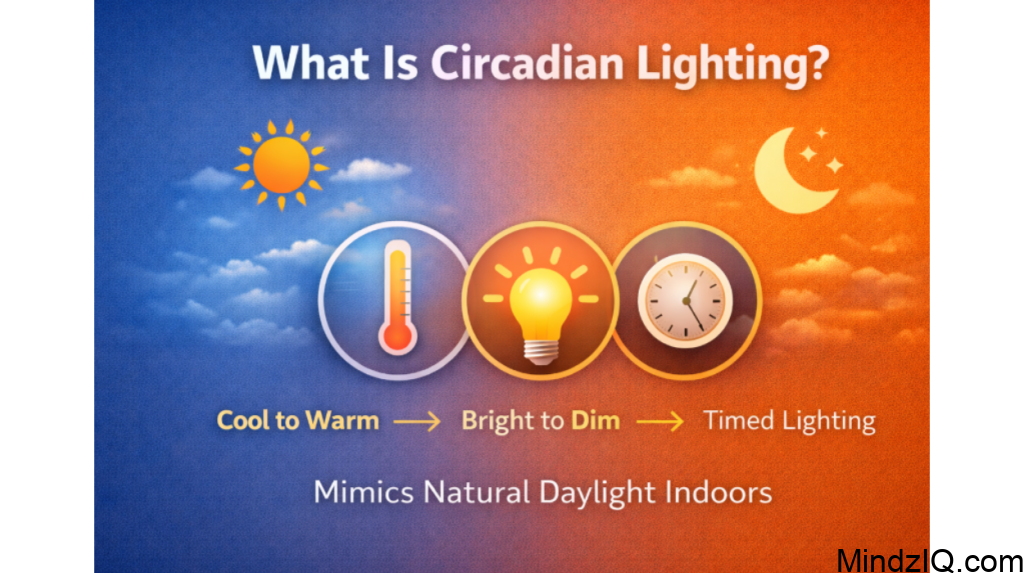
Our body regulates all its activities like sleep and wake, energy, focus, hormone secretion 24/7 which is called as circadian rhythm.
Natural sunlight is the basic sign that maintains this flow on track. Morning light is cooler and sharper. The evening light is warmer and softer. Your brain relies on these signals to help determine when it is time to wake up and when it is time to sleep
This is completely ignored by old style indoor lighting.
Circadian lighting replicates the natural pattern of daylight occurring indoors by changing:
Color temperature (cool ↔ warm)
Brightness (bright ↔ dim)
Timing (based on time of day)
When it’s done well, you don’t “notice” circadian lighting. You simply feel better about utilizing the space.
Why Automation Is Essential for Circadian Lighting
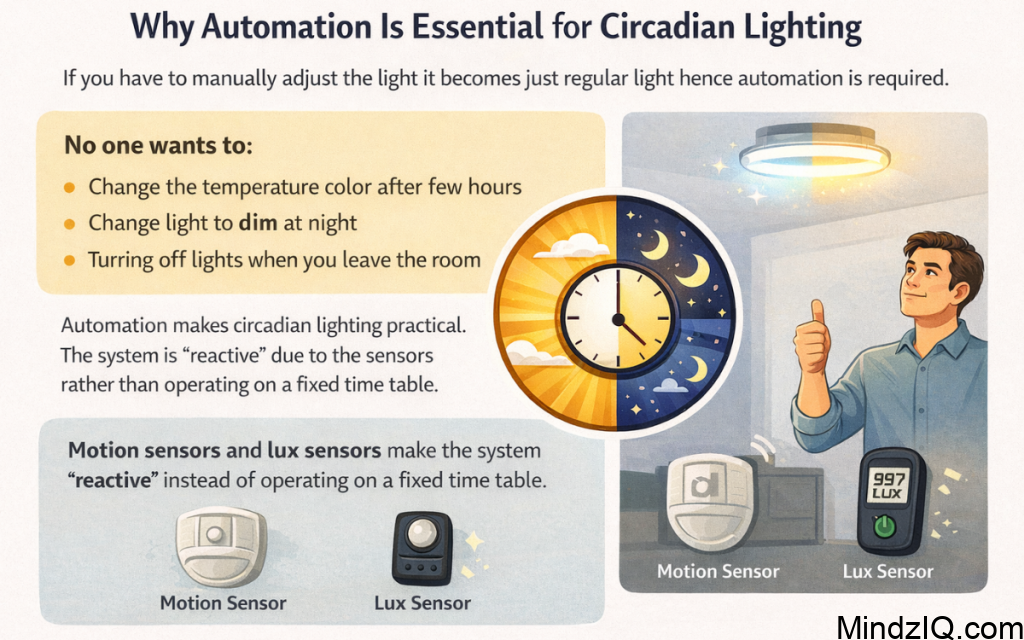
If you have to manually adjust the light it becomes just regular light hence automation is required.
No one wants to:
Change the temperature color after few hours
Change light to dim at night
Turing off lights when you leave the room
Automation makes circadian lighting practical. The system is “reactive” due to the sensors rather then operating on a fixed time table.
And here is where the motion sensors and lux sensors plays their role.
The Role of Motion Sensors in Circadian Lighting
Motion sensors works on one principal i.e. Is anyone actually here?
Motion sensors detects any movement in the living room and will turn on /off lights
What Motion Sensors Do?
- Turn on the lights when someone is in room
- Turn off lights when there is no any motion or room is empty
- It Prevents the wastage of energy
- Reduces manually turning on/off lights
The circadian logic works only when a person is present.
Common Types of Motion Sensors
- PIR (Passive Infrared): Detects the body heat movement
- Microwave: Motion is detected by Radio wave motion (more sensitive)
- mmWave (advanced): Presence is detected even when you are sitting still
For circadian lighting, PIR sensors can be used at home but for offices and smart buildings mmWave sensors plays major role as it do not turn off the lights on people sitting still.
Role of Lux Sensors (Ambient Light Sensor)
A lux sensor reads the amount of light already present in a space where it is placed.
This is important, and often ignored by the people
Lets Picture it, it’s an afternoon and light is coming through the windows. Motion sensor will turn on lights at full brightness. That’s wasteful and uncomfortable.
Lux sensors will fix this. What actually Lux sensors do:
- Measure natural and artificial daylight levels
- Turn off the lights which are not in use
- Dynamically Adjust the brightness
- visual comfort is consistently maintained
In circadian lighting, lux sensors are the reality checker. They make sure the system responds to real world conditions, rather than assumptions.
Read More: AI-Based Smart Home Automation Solutions.
Why Motion and Lux sensors works better Together
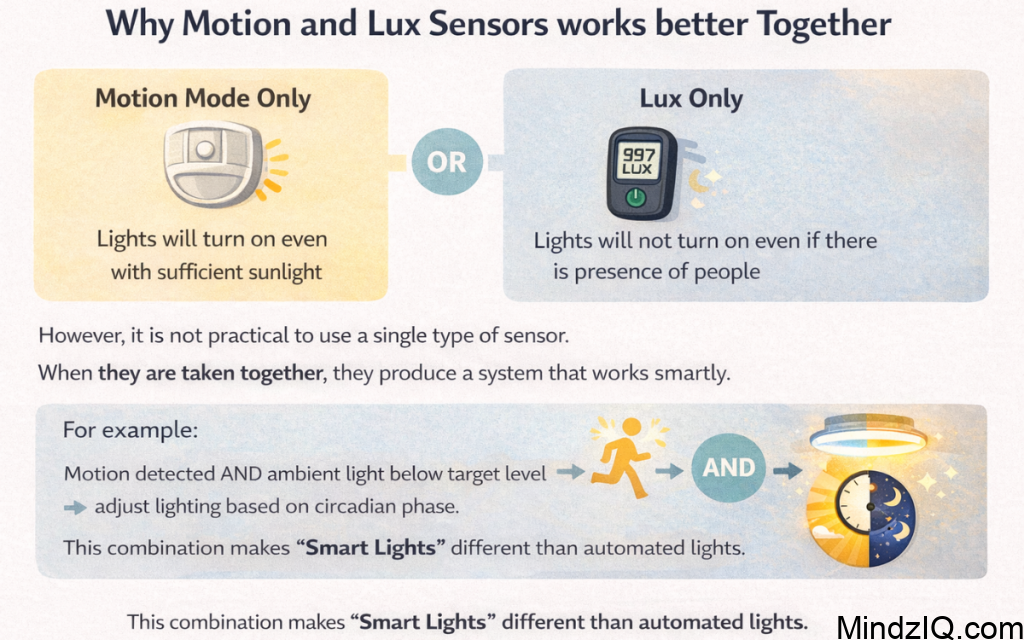
- Motion mode only: The lights will turn on even with sufficient sunlight
- Lux only: Lights will not turn on even if there is presence of people
However, it is not practical to use a single type of sensor.
When they are taken together, they produce a system that works smartly.
For example:
If Motion detected AND ambient light below target level → adjust lighting based on circadian phase. This combination makes “Smart Lights” different than automated lights.
Circadian Phases for Designing of Lights
The circadian system follows natural day not the clock.
1. Morning ( 6 AM to 10 AM)
The lights are cool white and brightness slowly increases from medium to high which makes you focused and alert.
2.Midday ( 10AM to 4 PM)
Brightness is balanced and gives productivity without eye strain
3. Evening (4 PM to 8 PM)
Lights are warm and body signals to slow down
4.Night (8 PM to 6 AM)
Lights are very warm, low brightness and melatonin suppression is minimized.
How a Motion and Lux Based Circadian Setup Actually Works
Let’s go through realistic example to know more about this
Example: Bedroom Lighting
1.Motion detected at 6:30 AM
- Lux sensor detects the low ambient light.
- System applies morning circadian profile
- Turns on gentle, cool light, not blinding
2.Sunlight increases by 9 AM
- Lux sensor detects sufficient light
- Artificial lights are turned down or off
3.Evening movement at 7 PM
- Motion detected
- Lux sensor reads low light
- Warm, dim lighting activates
4.Late night movement at 2 AM
- Motion detected
- Sub ambiance level amber light turns on
- No bright glare, no discomfort for your eyes, even when reading at night.
Sensor Placement Design
Bad sensor location ruins the good automation.
Motion Sensor Placement Tips:
- Do not place on top of HVAC vent
- Put it in main lines of movement, not on corners
- Avoid facing windows
- For a bigger room, use more sensors
Lux Sensor Placement Tips:
- Place where Natural light comes
- Prevent the sensor from direct sunlight
- Do not place near to the artificial lighting sources
- its calibration should be based on real world readings and not on the defaults
Improperly placed lux sensor may lead error light control.
Common Mistakes that should be avoided in Circadian Lighting Automation
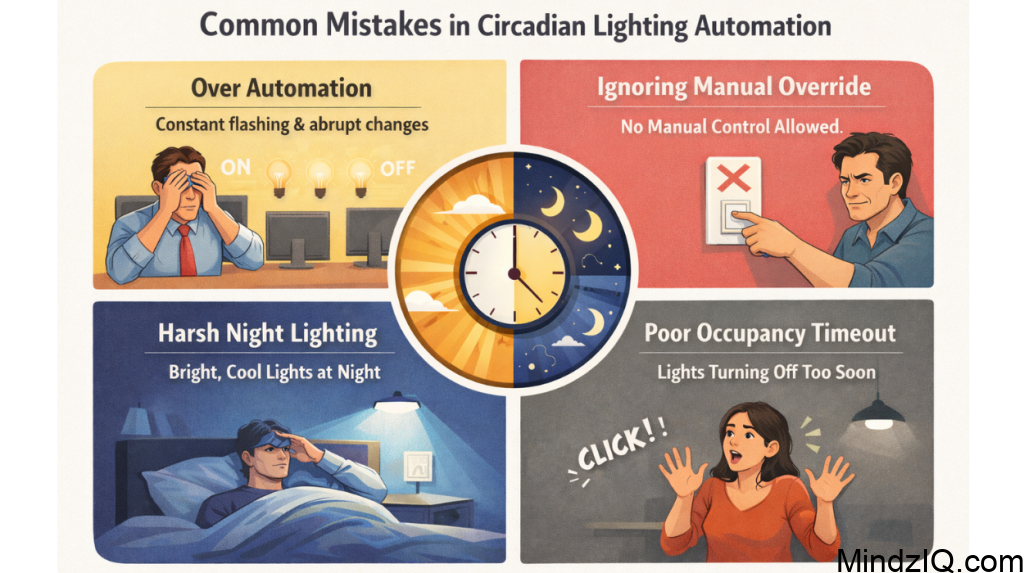
1. Over automation:
Lights should not continually flashing on and off every few minutes. Smooth transitions is required.
2. Ignoring manual override:
Always allow to the manual control as People should not get frustrated they need trust.
3. Harsh night lighting:
Don’t use the harsh light at night. Using blue or cool light at night just makes feel better.
4. A lack of occupancy timeout tuning:
Lights that switch off too soon will quickly break the your experience.
Real Benefits You Actually Notice
‘Human centric’ lighting with circadian control (utilizing motion and lux sensors) is done properly, users frequently comment:
- Better sleep quality
- Less eye strain
- Improved focus during the day
- Reduced headaches
- Lower energy bills
It doesn’t feel like technology. It feels like good design.
Conclusion
So, Circadian lighting is not an fancy technology or show off of smart features but its about respecting how humans actually works.
When motion sensor, Lux Sensor and circadian logic works together lights stops being that are manually controlled but starts to become that actually supports to you. So, It is light that actually respect to the human biology.